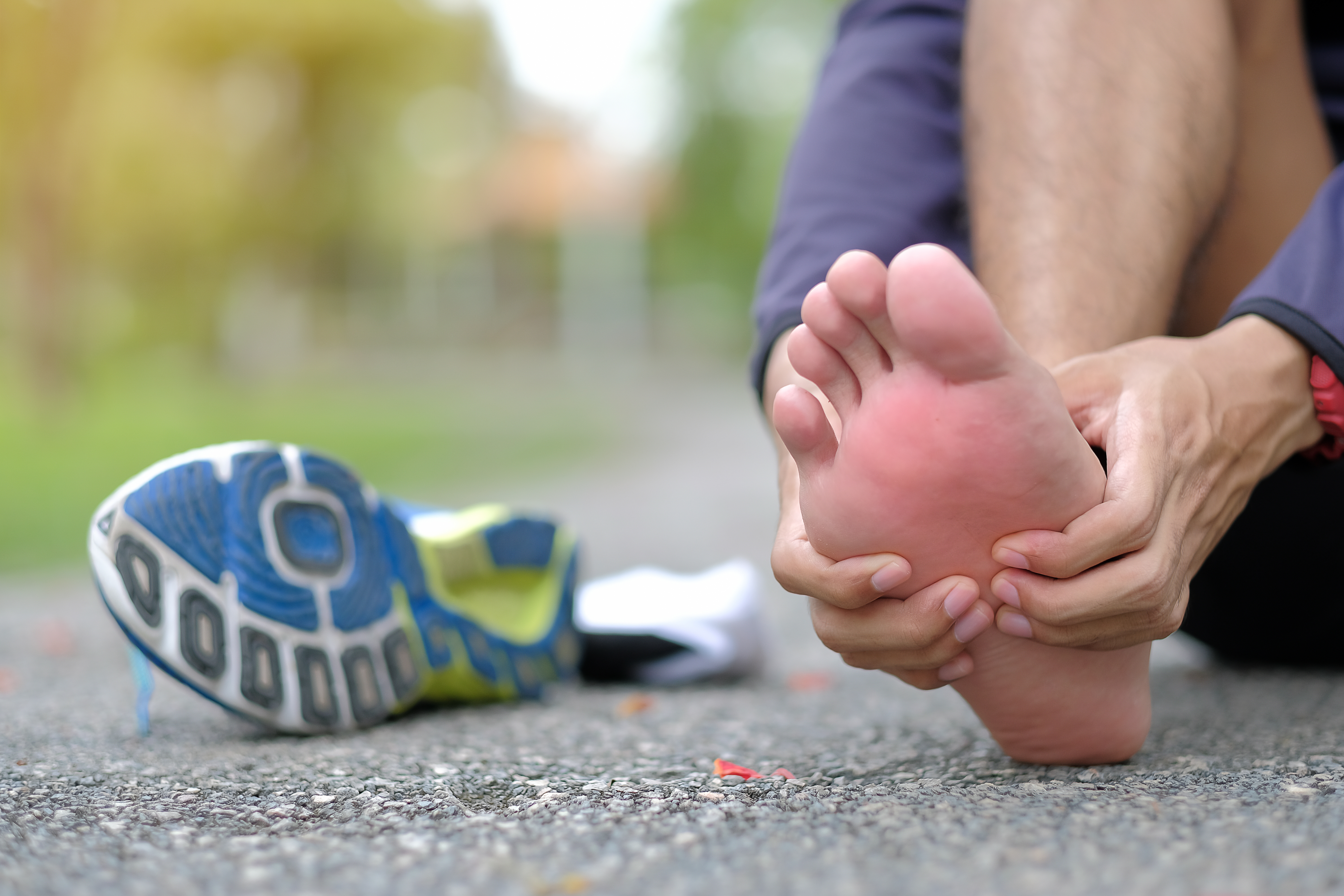
Young fitness man holding his sports leg injury, muscle painful during training. Asian runner having foot ache and problem after running and exercise outside in summer
A 43-year-old male accountant injures his great toe while playing softball. He reports a hyperextension injury. Radiographs show no fracture and no proximal shift of the sesamoids relative to the contralateral extremity. Magnetic resonance imaging is obtained and shows a partial tear of the plantar plate. His hindfoot alignment is neutral. Which of the following is the most appropriate treatment?
Immobilization in a controlled ankle movement boot for several weeks and then progressive activities with toe taping
A partial plantar plate tear can be successfully treated with a course of brief immobilization, with progressive return to activity while taping the toe.
Open operative repair of the plantar plate
Open operative repair is not indicated for the partial tear sustained by this patient. It would be indicated for a full tear with sesamoid retraction.
Semi-rigid custom orthotics with a lateral forefoot post
Custom orthotics might be offered after an initial period of immobilization in a boot. However, a lateral forefoot post would increase the load on the sesamoid. The more appropriate device would be an accommodative orthotic with a relief under the sesamoids.
Cast immobilization for 2 months
Cast immobilization may result in excessive stiffness and limitation.